WoowBot can help WooCommerce stores drive more checkouts by answering product questions, capturing buyer information through conversational forms, assisting shoppers through live chat, and bringing potential buyers back through WooCommerce retargeting. WoowBot can also reduce repetitive support workload, making WoowBot ROI measurable through additional orders, recovered sales opportunities, captured leads, and support hours saved.
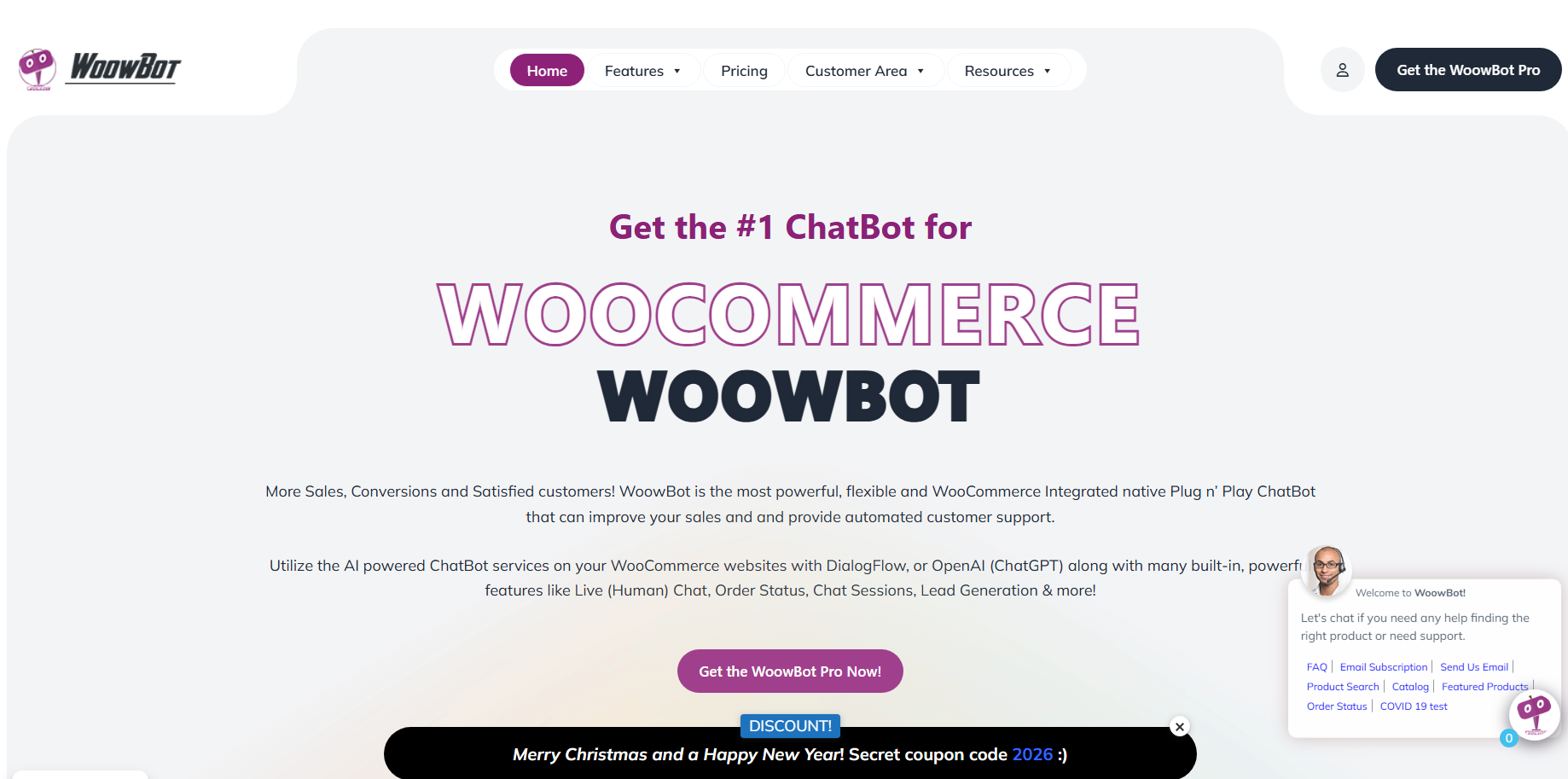
Can WoowBot Actually Pay for Itself?
WoowBot can pay for itself when the combination of additional WooCommerce revenue and reduced support workload exceeds the cost of running WoowBot.
WoowBot ROI does not depend on one magical conversion-rate number. WoowBot ROI comes from several smaller improvements working together: more product conversations, more completed forms, faster answers, fewer abandoned buying journeys, more recovered shoppers, and fewer repetitive support requests.
WoowBot gives WooCommerce stores a practical way to connect customer conversations with revenue. WoowBot can turn questions such as “Which product should I buy?”, “Does this work with my device?”, “Where is my order?”, or “Do you ship to my country?” into opportunities for engagement.
WoowBot becomes especially interesting when a WooCommerce store already receives enough traffic to generate recurring customer questions. WoowBot can handle many repetitive conversations while human agents concentrate on complex sales and support cases.
What Does a Simple WoowBot ROI Formula Look Like?
WoowBot ROI can be calculated with a straightforward formula:
WoowBot ROI = [(Incremental Revenue + Support Cost Savings) − WoowBot Cost] ÷ WoowBot Cost × 100
WoowBot ROI becomes easier to understand when a WooCommerce store separates revenue gains from operational savings.
For example, suppose a WooCommerce store generates $40,000 in monthly sales and WoowBot contributes an additional 3% in attributable revenue through assisted shopping, conversational forms, live chat, and retargeting.
WoowBot would be associated with approximately $1,200 in additional monthly revenue.
If WoowBot also saves 40 support hours per month at an estimated internal support cost of $8 per hour, WoowBot creates another $320 in operational savings.
WoowBot would therefore create approximately $1,520 in measurable monthly value before considering longer-term customer retention or repeat purchases.
| WoowBot ROI component | Example WooCommerce value |
| WoowBot-assisted incremental sales | $1,200/month |
| WoowBot support-hour savings | $320/month |
| WoowBot measurable monthly value | $1,520/month |
| WoowBot operating cost | Store-dependent |
| WoowBot ROI | Calculated from actual store cost |
WoowBot ROI should always use actual WooCommerce analytics rather than invented industry averages. WoowBot provides the mechanism; WooCommerce store data determines the financial result.
Why Are WooCommerce Customers Leaving Before Checkout?
WoowBot addresses a major WooCommerce problem: customers often leave because customers cannot quickly find enough information to make a purchase decision.
WoowBot can answer product questions directly inside the shopping experience. WoowBot can help customers compare products, understand specifications, find relevant products, and move toward checkout without forcing customers to search through multiple pages.
WoowBot can reduce friction around questions involving price, availability, compatibility, shipping, product specifications, returns, sizing, and purchasing decisions.
WoowBot becomes more valuable when the WooCommerce catalog contains hundreds or thousands of products. WoowBot can help shoppers navigate product information without requiring shoppers to understand the website’s entire navigation structure.
How Can WoowBot Turn Conversations Into WooCommerce Revenue?
WoowBot can connect customer intent with a specific next action.
WoowBot can recommend a product when a shopper describes a requirement. WoowBot can direct a shopper toward a product page, encourage a conversational form submission, connect a shopper with live chat, or support a returning shopper through a retargeting workflow.
WoowBot can therefore function as more than a traditional FAQ chatbot. WoowBot can operate as a conversational layer between WooCommerce traffic and commercial actions.
A useful WoowBot sales flow can look like this:
- WoowBot identifies buying intent.
- WoowBot asks relevant qualifying questions.
- WoowBot recommends or surfaces relevant WooCommerce products.
- WoowBot answers objections.
- WoowBot captures contact information when necessary.
- WoowBot directs the shopper toward checkout or human assistance.
- WoowBot supports follow-up or retargeting opportunities.
WoowBot makes each stage measurable when the WooCommerce store tracks conversation events, form submissions, product interactions, checkout starts, and completed orders.
Why Can WoowBot Conversational Forms Capture Revenue That Ordinary Forms Miss?
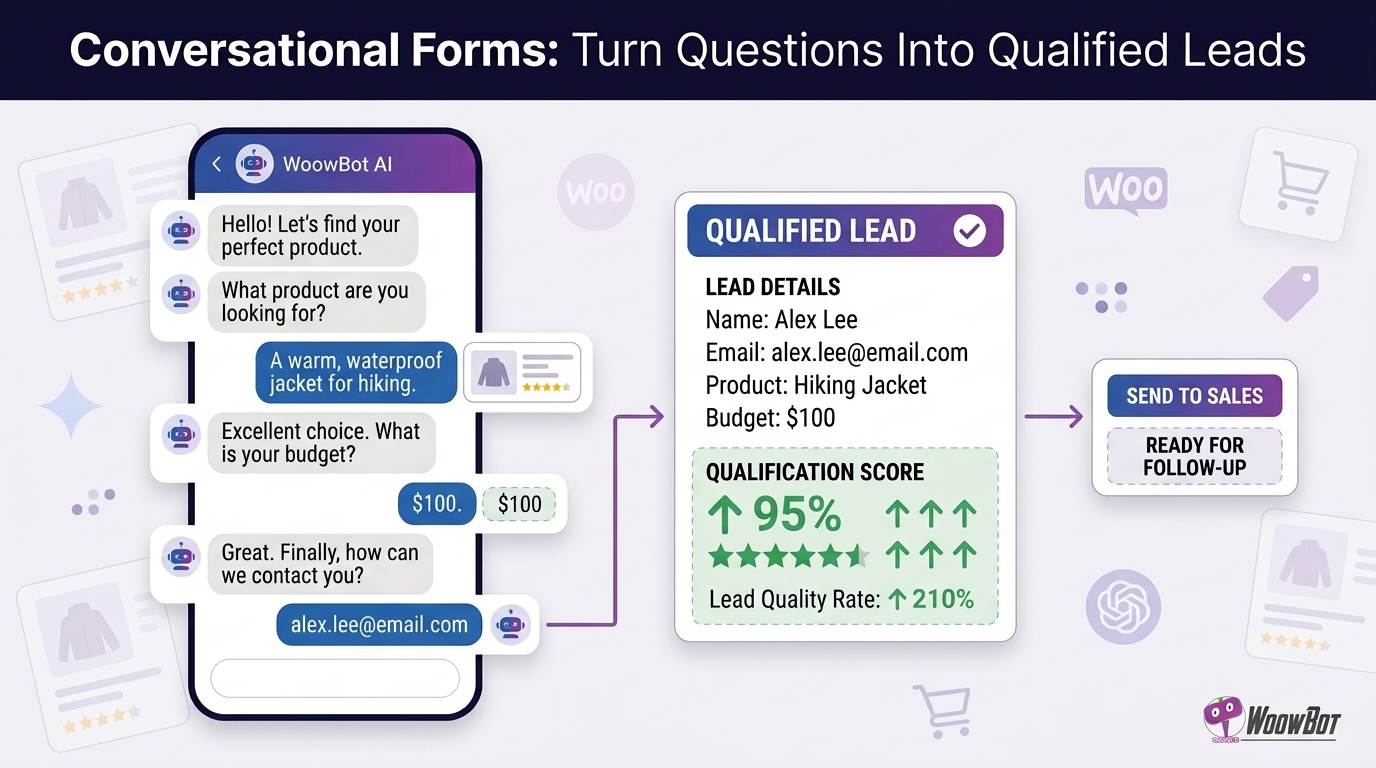
WoowBot conversational forms can turn a static lead form into an interactive qualification process.
WoowBot conversational forms can ask one question at a time instead of presenting shoppers with a large block of fields. WoowBot can make the information-collection process feel closer to a conversation than a traditional contact form.
WoowBot conversational forms can collect information such as name, email address, product requirement, budget, quantity, business requirement, preferred contact method, or purchasing timeframe.
WoowBot conversational forms become particularly useful when customers need help before purchasing. WoowBot can collect the minimum information required to continue the sales conversation instead of asking customers to complete a long traditional form.
Why Can WoowBot Conversational Forms Improve Lead Quality?
WoowBot conversational forms can qualify leads before a human salesperson becomes involved.
WoowBot can ask a customer what product the customer needs, what problem the customer wants to solve, what budget range the customer has, and when the customer plans to purchase.
WoowBot can use those answers to create a more useful lead record. WoowBot can therefore help sales teams prioritize high-intent prospects instead of treating every form submission identically.
WoowBot conversational forms can also reduce unnecessary back-and-forth communication. WoowBot can collect important context during the first interaction so a sales representative starts with useful information.
How Can WoowBot Conversational Forms Produce Measurable ROI?
WoowBot conversational-form ROI can be measured using a simple funnel:
Visitors → WoowBot conversations → WoowBot form starts → WoowBot form completions → Qualified leads → Orders
Suppose 10,000 monthly WooCommerce visitors interact with WoowBot and 4% start a conversational form.
WoowBot would generate approximately 400 form starts.
If WoowBot converts 45% of those starts into completed forms, WoowBot would produce approximately 180 leads.
If a WooCommerce store converts 12% of those qualified leads into customers, WoowBot could influence approximately 22 sales.
The actual numbers will vary significantly by product category, traffic quality, average order value, and sales cycle. WoowBot ROI analysis should therefore replace assumptions with measured WooCommerce and CRM data.
Why Does WoowBot Beat a Static Contact Form for High-Intent Shoppers?
WoowBot can adapt the conversation according to customer responses.
WoowBot can ask different questions for a customer looking for a laptop, a customer searching for a software product, and a customer requesting a bulk order. WoowBot can therefore make the qualification process more relevant than a single generic contact form.
WoowBot can also reduce the psychological friction associated with large forms. WoowBot can collect information progressively rather than asking customers to complete every field immediately.
WoowBot conversational forms are especially valuable when every qualified lead has meaningful commercial value.
Why Can WoowBot Live Chat Convert Questions Into Orders?
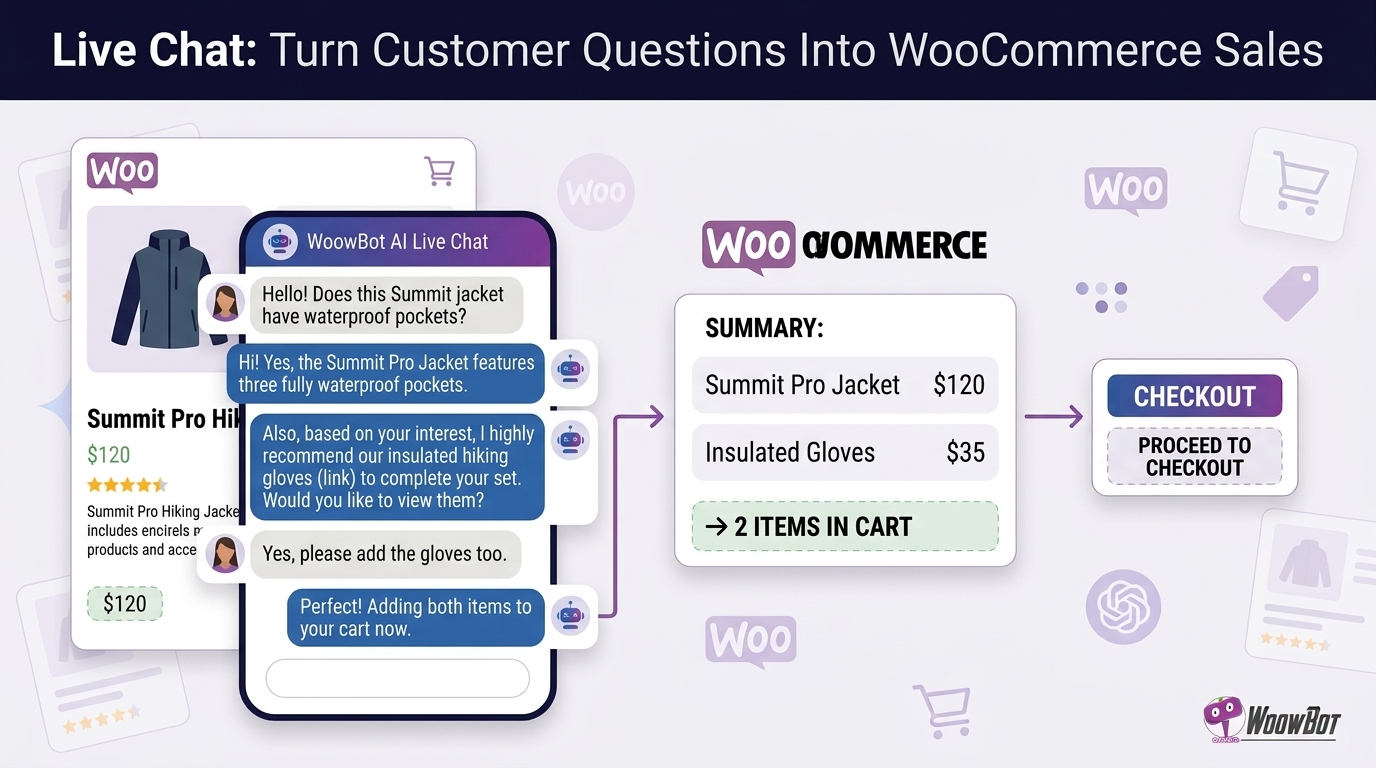
WoowBot live chat can address the moment when a shopper is closest to making a buying decision.
WoowBot live chat can provide immediate answers when customers hesitate because of product specifications, shipping details, compatibility, availability, installation requirements, or return policies.
WoowBot live chat can also provide an escalation path when automation is not enough. WoowBot can help route complex conversations toward human support while continuing to handle simpler questions automatically.
Why Does WoowBot Live Chat Matter When Customers Are Ready to Buy?
WoowBot live chat can reduce the delay between customer intent and customer action.
A shopper who has reached a product page may already understand the basic value proposition. WoowBot can help answer the final objection preventing the shopper from clicking Add to Cart or Buy Now.
WoowBot can therefore target a commercially valuable part of the customer journey rather than treating every website visitor equally.
WoowBot live chat can also operate outside normal business hours depending on the store’s configuration and connected services. WoowBot can continue answering supported questions when a human representative is unavailable.
How Can WoowBot Live Chat Reduce Support Costs?
WoowBot can automate repetitive questions that consume support-agent time.
WoowBot can handle recurring questions about shipping policies, return procedures, order information, product details, payment methods, store policies, and frequently requested documentation when the required information is available to WoowBot.
WoowBot can reduce the number of repetitive tickets reaching human agents. WoowBot therefore allows human support resources to focus on complex cases requiring judgment, investigation, or direct intervention.
WoowBot support savings can be calculated using:
Support Savings = Automated Conversations × Average Human Handling Cost per Conversation
For example, if WoowBot handles 1,000 repetitive conversations per month and the average human handling cost is estimated at $2.50 per conversation, WoowBot could represent approximately $2,500 of theoretical monthly workload capacity.
WoowBot ROI should not treat every automated conversation as direct cash savings. WoowBot ROI should distinguish between actual labor-cost reduction, avoided hiring, increased agent capacity, and time redirected toward revenue-generating work.
Can WoowBot Live Chat Increase Average Order Value?
WoowBot can potentially increase average order value by helping customers discover relevant products.
WoowBot can recommend complementary WooCommerce products when product relationships and catalog information support those recommendations. WoowBot can help customers discover accessories, related products, upgrades, or alternative products.
WoowBot can therefore influence both conversion rate and basket size.
A WoowBot-assisted order worth $120 creates substantially more incremental revenue than a WoowBot-assisted order worth $30. WoowBot ROI analysis should therefore track assisted revenue and average order value separately.
Why Is WooCommerce Retargeting the Missing Piece in WoowBot ROI?
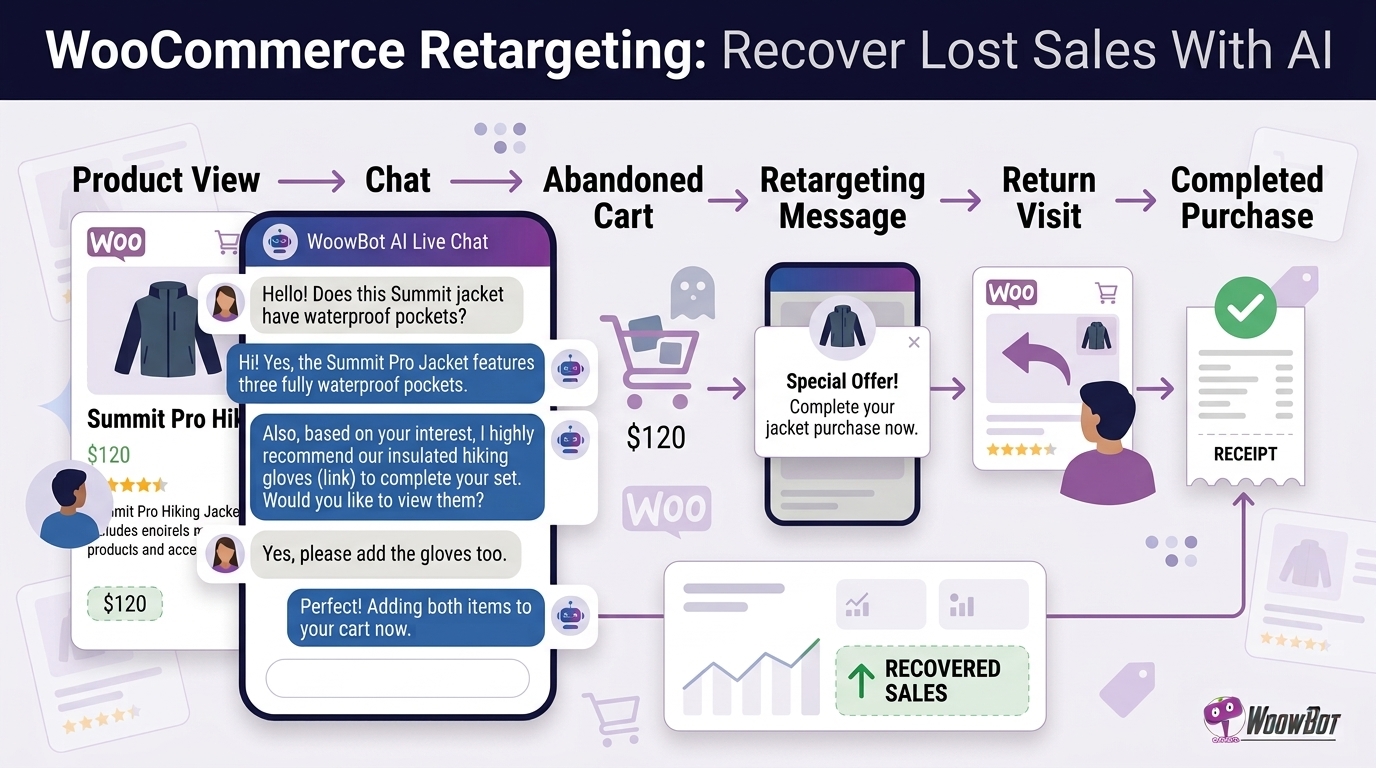
WoowBot WooCommerce retargeting can address shoppers who show interest but do not complete a purchase.
WoowBot can identify conversational buying intent and create opportunities for follow-up when appropriate integrations and consent mechanisms are configured. WoowBot retargeting can be particularly useful because many shoppers are not ready to purchase during the first website visit.
WoowBot can help WooCommerce stores think beyond the first conversation. WoowBot can turn a lost first-session opportunity into a potential second-session conversion.
How Can WoowBot Retarget Shoppers Who Do Not Buy?
WoowBot retargeting can begin with behavioral signals such as product interest, conversation activity, form completion, or abandoned purchasing intent.
WoowBot can connect relevant customer information with supported marketing workflows through integrations or webhooks. WoowBot can therefore help move qualified prospects into appropriate follow-up systems rather than leaving customer intent trapped inside a chat window.
WoowBot retargeting should always respect applicable privacy requirements and customer consent. WoowBot should not treat customer data as freely reusable marketing data without appropriate legal and technical controls.
Why Can WoowBot Retargeting Recover More Than a Single Checkout?
WoowBot can support multiple stages of the customer lifecycle.
WoowBot can help re-engage shoppers who asked product questions but did not purchase. WoowBot can also support follow-up workflows for leads who submitted information but did not immediately become customers.
WoowBot retargeting becomes more powerful when customer segmentation is specific.
Examples of useful WoowBot-oriented segments include:
- WoowBot product-question visitors who asked about a specific WooCommerce product but did not purchase.
- WoowBot conversational-form leads who submitted contact information but did not complete a sale.
- WoowBot high-intent shoppers who discussed purchasing requirements but left before checkout.
- WoowBot repeat visitors who previously interacted with WoowBot about related products.
- WoowBot support customers who may have future purchasing opportunities after a successful support interaction.
WoowBot segmentation should avoid unnecessary personal-data collection. WoowBot should collect only the information required for the intended customer experience and business process.
How Much Can WoowBot ROI Improve When All Three Pillars Work Together?
WoowBot becomes more valuable when conversational forms, live chat, and retargeting operate as connected parts of one WooCommerce funnel.
WoowBot conversational forms can capture intent. WoowBot live chat can resolve objections. WoowBot WooCommerce retargeting can recover qualified shoppers who leave before purchasing.
| WoowBot capability | Primary commercial objective | Useful KPI |
| WoowBot Conversational Forms | Capture and qualify leads | Form completion rate |
| WoowBot Live Chat | Resolve purchase objections | Assisted conversion rate |
| WoowBot Product Assistance | Improve product discovery | Product click-through rate |
| WoowBot Retargeting | Recover lost opportunities | Returning conversion rate |
| WoowBot Support Automation | Reduce repetitive workload | Automated resolution rate |
WoowBot ROI should measure the three pillars separately before combining the numbers. WoowBot analytics become more useful when store owners can identify which activity produced revenue and which activity produced operational savings.
What Would a Realistic WoowBot ROI Scenario Look Like?
Consider a hypothetical WooCommerce store generating $50,000 monthly revenue with an average order value of $100.
WoowBot influences an additional 20 orders per month through product assistance, live chat, conversational forms, and retargeting. WoowBot would associate with $2,000 in incremental monthly revenue.
WoowBot also reduces repetitive support workload by 50 hours monthly. At an estimated support cost of $10 per hour, WoowBot represents another $500 in monthly operational value.
WoowBot therefore produces $2,500 of combined monthly value in this example.
The scenario is illustrative rather than a guaranteed WoowBot performance benchmark. WoowBot ROI should be calculated from actual WooCommerce orders, attributable conversations, support workload, and marketing data.
How Does WoowBot Compare With Monthly SaaS Chatbots?
WoowBot can be evaluated differently from subscription-heavy chatbot services because WooCommerce stores should consider total ownership cost rather than monthly software price alone.
| Cost or capability | WoowBot | Typical SaaS chatbot model |
| WooCommerce integration | WoowBot-focused workflow | Often plan-dependent |
| Conversational forms | WoowBot capability | Often tier-dependent |
| Live chat | WoowBot capability | Often tier-dependent |
| AI provider flexibility | WoowBot can support configured AI integrations | Frequently vendor-controlled |
| Data ownership considerations | WoowBot operates within WordPress infrastructure and configured services | SaaS provider infrastructure |
| Monthly subscription pressure | Depends on WoowBot licensing and AI usage | Commonly recurring |
| Scaling cost | WoowBot cost depends on hosting, AI usage, and license structure | Often tied to seats, messages, contacts, or usage |
| WooCommerce product conversations | WoowBot-oriented | Depends on SaaS integration |
WoowBot ROI should include hosting, AI API usage, licensing, maintenance, and support requirements. WoowBot should not be compared against a SaaS subscription using license price alone.
Can WoowBot Reduce Support Costs Without Sacrificing Customer Experience?
WoowBot can reduce support workload without attempting to automate every customer interaction.
WoowBot should automate predictable, information-based conversations while escalating conversations that require human judgment. WoowBot can therefore function as a first-line support layer rather than a mandatory replacement for human support.
WoowBot support automation works best when the underlying knowledge is accurate and regularly maintained. WoowBot should not confidently provide outdated information about pricing, availability, policies, shipping, or product specifications.
How Should Developers Measure WoowBot ROI Correctly?
WoowBot ROI tracking should use a baseline period before optimization.
WoowBot developers and store owners should record at least:
- WoowBot conversation volume
- WoowBot unique users
- WoowBot conversational-form starts
- WoowBot conversational-form completions
- WoowBot qualified leads
- WoowBot product interactions
- WoowBot checkout starts
- WoowBot assisted orders
- WoowBot attributed revenue
- WoowBot automated support resolutions
- WoowBot human escalation volume
- WoowBot AI API expenditure
WoowBot ROI becomes much more defensible when the store compares these metrics against the same metrics from a pre-WoowBot baseline.
What Should WooCommerce Stores Avoid When Calculating WoowBot ROI?
WoowBot ROI calculations can become misleading when every conversation is treated as a sale.
WoowBot should not receive 100% attribution for an order simply because a shopper opened the chat widget. WoowBot attribution should use defined rules such as last interaction, assisted conversion, multi-touch attribution, or an agreed internal attribution model.
WoowBot ROI should also separate revenue attribution from revenue influence. WoowBot may influence a customer decision without being the sole reason a customer purchased.
What Technical Objections Should Developers Consider Before Deploying WoowBot?
WoowBot deployment should be evaluated as a WordPress and WooCommerce engineering project rather than only as a marketing installation.
WoowBot performance depends on WordPress hosting capacity, WooCommerce catalog size, JavaScript execution, database configuration, external API response times, caching architecture, webhook design, and AI provider usage.
WoowBot developers should therefore evaluate infrastructure before scaling WoowBot across high-traffic stores.
Can WoowBot Create Significant Server Resource Overhead?
WoowBot server overhead depends on the exact WoowBot configuration, conversation volume, WordPress environment, integrations, logging strategy, and AI architecture.
WoowBot requests that require external AI APIs can shift computational work from the WordPress server to the configured AI provider, although WordPress still handles browser requests, authentication, plugin logic, data processing, and integration workflows.
WoowBot deployments should use proper caching, efficient database queries, optimized WordPress hosting, and controlled logging. WoowBot developers should monitor PHP workers, memory consumption, CPU usage, database load, and response time rather than assuming WoowBot has a fixed resource footprint.
How Should WoowBot Developers Manage OpenAI, Gemini, and DeepSeek API Token Billing?
WoowBot AI usage can generate variable API costs because token consumption depends on conversation length, model selection, prompt size, retrieved context, response length, and traffic volume.
WoowBot administrators should define model policies, conversation limits, maximum response lengths, and monitoring thresholds. WoowBot deployments should also prevent unnecessarily large prompts from being sent repeatedly to AI providers.
WoowBot developers can calculate estimated AI cost using:
WoowBot AI Cost = Input Tokens × Input Rate + Output Tokens × Output Rate
WoowBot cost monitoring should be performed at the provider-account level and, where technically available, correlated with WooCommerce conversation volume. WoowBot can support multiple AI integrations, but exact model availability, API pricing, billing rules, and token rates depend on the configured provider and current provider policies.
How Should WoowBot Handle GDPR and Customer Privacy Data?
WoowBot privacy architecture should follow data minimization, purpose limitation, access control, retention policies, and applicable GDPR requirements.
WoowBot should avoid collecting sensitive personal information unless the business has a valid legal basis and an explicit operational requirement. WoowBot conversational forms should request only the fields necessary for the intended sales or support workflow.
WoowBot developers should document what information is stored in WordPress, what information is sent to external AI providers, what information is sent through webhooks, how long information is retained, and who can access stored conversations.
WoowBot deployments serving European customers should also evaluate consent requirements, processor relationships, international data transfers, deletion workflows, and applicable privacy notices with qualified legal guidance.
How Should WoowBot Developers Handle Historical Security Patches and Vulnerability Concerns?
WoowBot security should be evaluated using the current release, current dependencies, WordPress security practices, and the current vendor security record rather than relying on assumptions about any historical software issue.
WoowBot administrators should keep WoowBot, WordPress, WooCommerce, PHP, themes, and related extensions updated according to a controlled maintenance process. WoowBot deployments should also use least-privilege WordPress permissions, secure authentication, HTTPS, backups, malware monitoring, and appropriate firewall controls.
WoowBot developers should verify security advisories and changelogs from authoritative sources before making claims about historical vulnerabilities. WoowBot security should never depend on an outdated version remaining installed indefinitely.
How Can WoowBot Reduce Webhook Latency?
WoowBot webhook latency depends on the receiving endpoint, network conditions, DNS resolution, TLS negotiation, server processing, queue architecture, and external API response times.
WoowBot developers should use asynchronous processing whenever a webhook action does not need to block the customer’s immediate conversation. WoowBot can send an event to a queue and allow background processing to handle CRM synchronization, analytics, notifications, or secondary automation.
WoowBot webhook architecture should also include request authentication, timeout limits, retries with backoff, idempotency protection, logging, and failure monitoring. WoowBot developers should avoid making the customer wait for several external services before returning a chat response.
Can WoowBot Really Pay for Itself?
WoowBot can pay for itself when measurable incremental WooCommerce revenue and measurable operational savings exceed the combined cost of WoowBot licensing, hosting, AI usage, maintenance, and related services.
WoowBot’s strongest ROI opportunity comes from combining conversational forms, live chat, and WooCommerce retargeting instead of treating AI chat as a standalone FAQ widget.
WoowBot conversational forms can capture and qualify demand. WoowBot live chat can remove purchase objections. WoowBot WooCommerce retargeting can recover shoppers who show intent but leave before completing checkout.
WoowBot ROI should ultimately be judged by business metrics rather than chatbot activity. WoowBot becomes financially meaningful when WoowBot helps generate more orders, recover more opportunities, capture better leads, and reduce repetitive support work than WoowBot costs to operate.
What Is the Fastest Way to Prove WoowBot ROI?
WoowBot ROI can be tested with a controlled measurement period.
WoowBot store owners should establish a baseline, launch targeted WoowBot experiences, track assisted conversations and orders, measure support workload changes, monitor AI costs, and compare the results against the baseline.
WoowBot does not need to transform every visitor into a customer to produce positive ROI. WoowBot only needs to create enough additional commercial value and operational efficiency to exceed the total cost of WoowBot ownership.
FAQ’s
WoowBot can pay for itself when the combination of additional WooCommerce revenue and reduced support workload exceeds the cost of running WoowBot.
WoowBot ROI = [(Incremental Revenue + Support Cost Savings) − WoowBot Cost] ÷ WoowBot Cost × 100
Customers often leave because they cannot quickly find enough information to make a purchase decision, which WoowBot addresses by answering product questions directly inside the shopping experience.
WoowBot can connect customer intent with a specific next action, recommend products, direct shoppers toward checkout, and support retargeting workflows, functioning as a conversational layer between traffic and commercial actions.
WoowBot conversational forms turn a static lead form into an interactive qualification process by asking one question at a time and collecting essential information to continue the sales conversation.
WoowBot can automate repetitive questions, handle recurring inquiries, and reduce the number of repetitive tickets reaching human agents, allowing them to focus on complex cases.
WoowBot can potentially increase average order value by recommending complementary products, influencing both conversion rate and basket size.
WoowBot WooCommerce retargeting can address shoppers who show interest but do not complete a purchase, turning lost opportunities into potential second-session conversions.