WoowBot helps WooCommerce businesses guide shoppers toward checkout through AI-powered product discovery, Conversational Forms, and Live Chat that can address buying questions before hesitation turns into an abandoned visit. WoowBot also supports smarter WooCommerce retargeting workflows, helping store owners reconnect with interested shoppers and turn customer interactions into measurable sales opportunities.
Why Could Your Next Best-Selling Product Be Hiding in Customer Conversations?
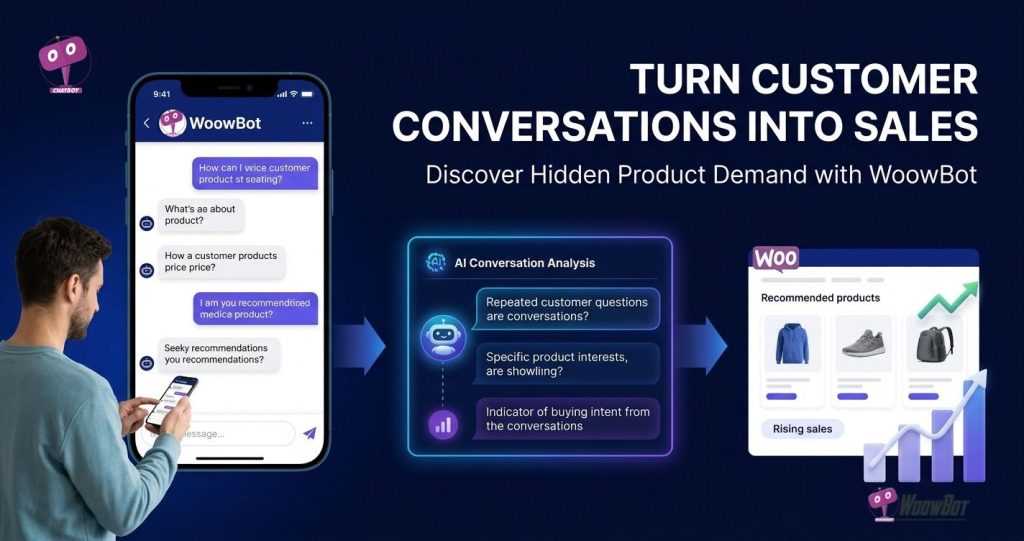
Your WooCommerce sales reports show what customers purchased yesterday, but customer conversations can reveal what shoppers want today and what your store may be missing tomorrow. WoowBot gives WooCommerce businesses a conversational channel for discovering product questions, purchase objections, and customer needs that deserve closer attention.
A shopper might ask for a laptop stand that fits a particular desk, a phone case compatible with a specific model, or a replacement accessory that never appears in your catalog. Each question represents a possible sales opportunity, but repeated questions can reveal a larger demand pattern worth investigating.
WoowBot should not be treated as an automatic market-prediction engine. WoowBot can help businesses collect conversational signals, guide product discovery, and support follow-up workflows, while store owners validate demand against sales data, stock availability, and actual customer behavior.
Are Your WooCommerce Sales Reports Showing Only Half the Story?
WooCommerce order reports explain completed purchases, average order value, refunds, and product performance. WoowBot conversations can add another perspective by showing what customers ask before purchasing, including questions that never result in an order.
Consider a WooCommerce store selling wireless headphones. Sales reports might identify the bestselling headphones, while WoowBot conversations reveal repeated questions about replacement ear cushions, USB-C charging cables, and compatibility with gaming consoles.
Those questions do not prove that every shopper will buy an accessory. WoowBot conversation patterns can, however, help the store owner identify products worth testing before committing to a larger inventory order.
What Can WoowBot Reveal That Your Product Analytics Might Miss?
Traditional analytics tools measure events such as product views, add-to-cart actions, checkout starts, and completed orders. WoowBot conversations can capture the context behind those events when shoppers explicitly describe their requirements or concerns.
WoowBot can support investigations into several useful signals:
- Unmet product needs: WoowBot conversations may reveal repeated requests for products or variations missing from the catalog.
- Purchase objections: WoowBot can help surface questions about compatibility, sizing, shipping, returns, and product quality.
- Accessory opportunities: WoowBot interactions may expose interest in complementary products that deserve merchandising tests.
- Decision barriers: WoowBot can help shoppers obtain information before deciding whether a product suits their needs.
- Customer preferences: WoowBot Conversational Forms can collect structured answers about requirements, budgets, and intended use.
The business value comes from combining WoowBot conversational signals with reliable store data. Store owners should investigate recurring patterns rather than treating a single question as proof of market demand.
How Can WoowBot Turn Everyday Questions Into Product Research?
WoowBot can make customer research part of ordinary shopping interactions instead of requiring a separate survey campaign. A shopper asking about a product can receive assistance while the business identifies useful questions to investigate later.
For example, a WooCommerce store selling home-office equipment might receive repeated questions about compact desks, adjustable monitor arms, and cable-management accessories. WoowBot can help visitors navigate relevant products, while the store owner reviews conversation records or available reporting capabilities to identify recurring needs.
The important distinction is between collecting a signal and proving a business opportunity. WoowBot can support the collection and handling of customer questions, but demand validation still requires careful analysis.
Can WoowBot Identify Products Customers Cannot Find?
Product discovery becomes difficult when shoppers use different words from the product titles in a WooCommerce catalog. WoowBot can help visitors search for relevant products through conversational questions rather than requiring every shopper to understand the store’s category structure.
Imagine a customer asking for a quiet keyboard for a shared office. A WooCommerce store might list products under mechanical keyboards, wireless keyboards, and office accessories, but the shopper begins with a practical requirement rather than a category name.
WoowBot can help guide the shopper toward relevant products when the configured chatbot integrations, product information, and search capabilities support the request. Repeated searches for products that cannot be found should prompt the store owner to investigate catalog organization, product attributes, and possible assortment gaps.
Could WoowBot Reveal Demand for Products You Do Not Stock?
A missing product can create an opportunity, but a request alone does not establish profitable demand. WoowBot conversations can help identify repeated requests for unavailable sizes, colors, accessories, brands, or product categories.
Consider a WooCommerce store selling travel backpacks. If shoppers repeatedly ask about waterproof laptop sleeves, compact packing cubes, or luggage straps, the store owner can investigate whether related products would fit the existing audience.
A sensible evaluation should consider at least four factors:
- Request frequency: How many distinct shoppers ask for the product during a defined period?
- Purchase intent: Do shoppers ask about price, delivery, compatibility, or availability?
- Commercial viability: Can the store source the product at a margin that covers acquisition, fulfillment, and support costs?
- Existing demand evidence: Do search data, sales records, customer surveys, or small product tests support the opportunity?
WoowBot can help expose the questions that start this investigation. The store owner must still verify supplier quality, pricing, demand, and profitability.
Can WoowBot Conversational Forms Collect Better Buying Signals?
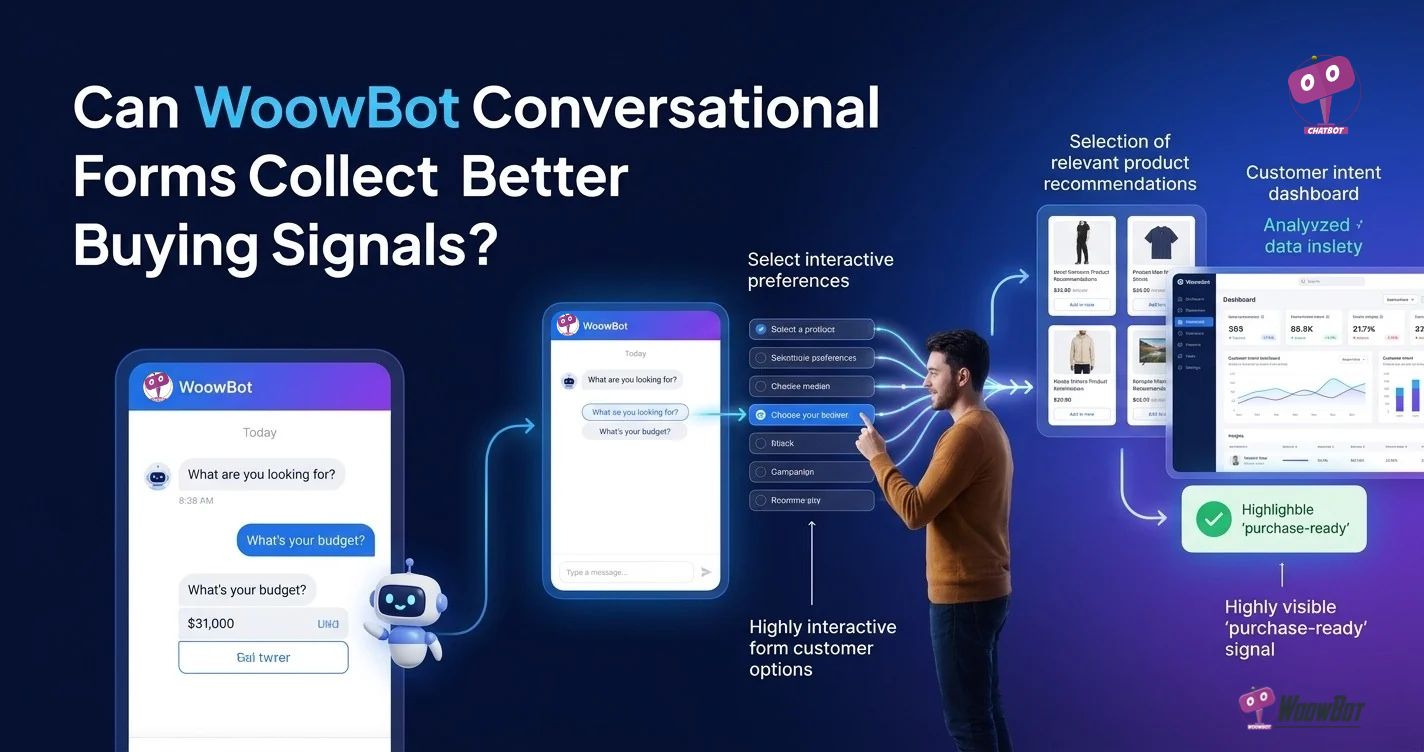
WoowBot Conversational Forms can help WooCommerce businesses collect information through guided questions rather than relying entirely on open-ended chat messages. Structured responses are particularly useful when shoppers have specific requirements that affect product selection.
A store selling ergonomic chairs might ask visitors about their budget, preferred chair type, approximate height range, and primary use. WoowBot Conversational Forms can support a guided collection process when the relevant form is configured to capture those fields.
The resulting answers can help the store understand customer requirements more consistently. Any claim about automatic analytics, segmentation, or report generation should be verified against the exact WoowBot version and integrations in use.
Which Questions Should WoowBot Ask Without Frustrating Shoppers?
A useful WoowBot Conversational Form should collect information that helps the shopper make a decision. Every additional question adds friction, so store owners should prioritize fields that materially affect product recommendations or follow-up.
For a WooCommerce store selling computer accessories, a short WoowBot Conversational Form might ask:
- Device model: Which laptop, tablet, or phone does the customer use?
- Primary requirement: Does the customer need charging, protection, connectivity, or improved performance?
- Budget range: What price range would the customer prefer?
- Purchase timing: Does the customer need the product immediately or plan to buy later?
- Preferred contact method: Does the customer want a response by email or another supported channel?
WoowBot Conversational Forms should avoid collecting sensitive information that is unnecessary for product discovery. A short, relevant form is generally easier to complete than a long questionnaire presented before a shopper receives useful assistance.
How Can WoowBot Turn Form Responses Into Product Opportunities?
WoowBot Conversational Forms can capture structured customer preferences that businesses can review alongside product and order data. A consistent set of fields makes it easier to compare similar requests across a defined period.
For example, a store might discover that many shoppers prefer accessories below a particular price threshold or need compatibility with a device model that receives little attention in current product descriptions. WoowBot form responses can help identify the pattern, while sales and search data determine whether the opportunity deserves a commercial test.
Store owners should confirm whether the installed WoowBot configuration supports the required form fields, exports, integrations, and reporting. A reliable workflow should never assume that collecting a response automatically creates a complete market-research dashboard.
Can WoowBot Conversational Forms Reduce Unqualified Leads?
A lead becomes more useful when the business understands the shopper’s actual requirement. WoowBot Conversational Forms can help qualify product inquiries by asking a small number of relevant questions before a salesperson follows up.
For a WooCommerce store selling commercial equipment, a form might capture the intended application, quantity, budget, and expected purchase date. WoowBot can help gather the information needed to route the inquiry appropriately when the configured workflow supports that routing.
The objective is not to force every visitor into a lead form. WoowBot should give shoppers a useful route to product information first and offer structured questions when additional details can improve the buying experience.
Can WoowBot Live Chat Turn Purchase Hesitation Into Useful Intelligence?
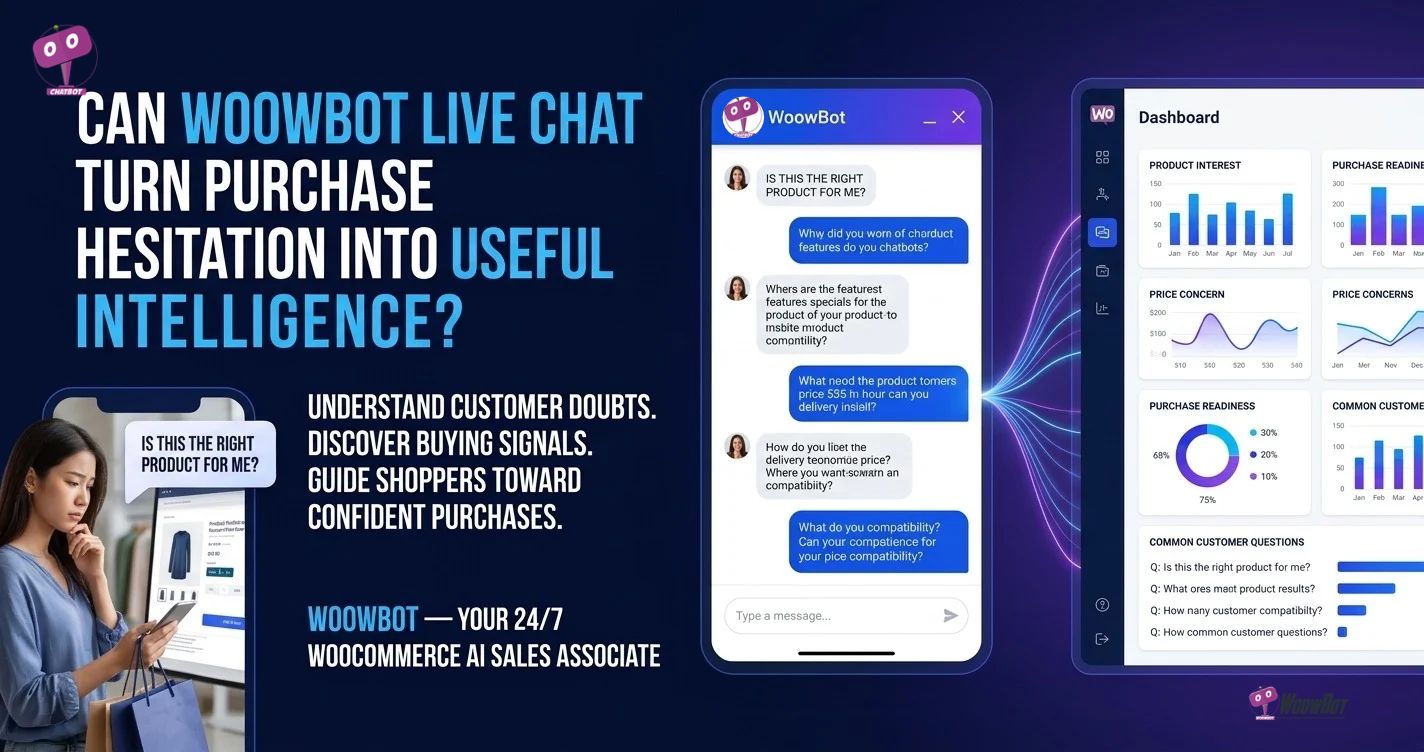
Live Chat gives shoppers a way to ask questions when product descriptions do not answer their concerns. WoowBot Live Chat can support conversations about product suitability, ordering questions, and requests that need additional assistance, depending on the installed configuration.
A shopper comparing two similar products may need clarification about warranty coverage, compatibility, dimensions, or shipping. WoowBot can help deliver relevant answers when the necessary information and integrations are available, reducing the need for shoppers to search across several pages.
Those conversations can also reveal weaknesses in the store’s product information. If shoppers repeatedly ask the same question, the store owner should consider improving product descriptions, comparison tables, FAQs, or product photography.
What Do Repeated WoowBot Live Chat Questions Say About Your Product Pages?
Repeated questions often indicate a gap between the information customers need and the information the store provides. WoowBot Live Chat can make those questions visible to the business when conversation history or appropriate records are available.
Consider a WooCommerce store selling portable power stations. If shoppers repeatedly ask whether a model can power a particular appliance, the store may need a clearer compatibility guide and realistic runtime examples.
WoowBot conversation records can help the business identify the recurring concern. The store owner should then verify the technical answer, update the relevant product page, and measure whether the number of similar questions or the product’s conversion rate changes afterward.
Can WoowBot Help Separate Price Objections From Product Confusion?
A customer who does not purchase may be concerned about price, but price is not always the real barrier. WoowBot Live Chat can help shoppers explain whether they need a cheaper alternative, more technical information, delivery clarification, or reassurance about product suitability.
A WooCommerce store selling wireless microphones might receive questions about recording quality, smartphone compatibility, battery life, and background noise. Each question requires a different response, and a discount alone will not resolve every concern.
Store owners can categorize WoowBot conversations into practical groups such as pricing, compatibility, availability, delivery, returns, and product education. Comparing those categories with add-to-cart and purchase events can help identify which barriers deserve the most attention.
How Should WoowBot Handle Questions That Need Human Expertise?
An AI chatbot should not invent technical specifications, warranty terms, delivery promises, or safety guidance. WoowBot should provide answers from reliable configured information and offer an appropriate escalation route when a question exceeds the chatbot’s available knowledge or authority.
A WooCommerce store selling electrical equipment should be especially careful with questions about voltage, power limits, installation, and product safety. WoowBot workflows should direct uncertain or high-risk questions to a qualified support representative rather than presenting an unverified answer as fact.
Human review also improves product research quality. A support team can distinguish a genuine unmet need from a misunderstanding caused by unclear product descriptions or incomplete product data.
How Can WooCommerce Retargeting Turn Conversational Interest Into Sales?
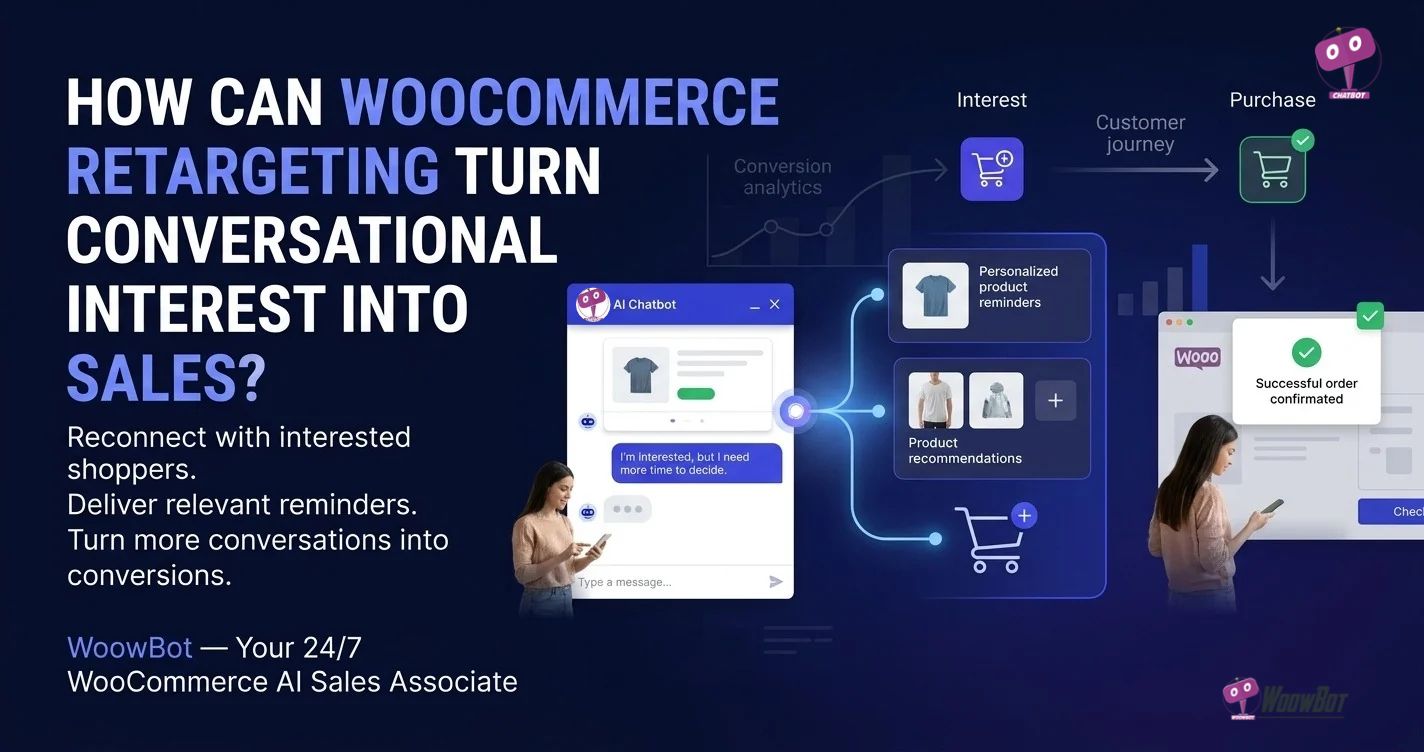
WooCommerce retargeting helps businesses reconnect with shoppers who showed interest but did not complete a purchase. WoowBot can contribute to a broader retargeting strategy by supporting product discovery and customer interactions, while configured integrations and consent-compliant marketing tools handle the relevant follow-up actions.
A shopper might ask WoowBot about a pair of headphones, compare two models, and leave without ordering. That interaction may indicate interest, but the store should not assume that the shopper has consented to marketing messages or that WoowBot automatically creates an advertising audience.
A useful workflow connects appropriate customer events, permitted data collection, and a relevant next step. The store owner must verify which tracking, audience, webhook, and marketing integrations are available in the actual WoowBot setup.
Which WoowBot Signals Are Worth Using for Retargeting?
Not every chatbot interaction deserves the same follow-up. A visitor who asks a general question may have less immediate buying intent than a visitor who requests a quote or asks about delivery for a specific product.
WooCommerce businesses can use the following signals to design their measurement and retargeting strategy, provided the required events are captured by supported tools:
- Product-specific questions: A shopper asks about a named product or a particular model.
- Compatibility questions: A shopper needs confirmation before choosing a product.
- Availability inquiries: A shopper asks when a product or variation will return to stock.
- Conversational Form submissions: A shopper voluntarily provides buying requirements or requests contact.
- Cart or checkout activity: WooCommerce records a relevant event through the store’s configured tracking system.
WoowBot can support the conversational part of the customer journey. Store owners should validate event tracking and audience creation separately rather than assuming every conversation automatically becomes a retargeting event.
How Can WoowBot Support a More Relevant Follow-Up Strategy?
Effective retargeting responds to the shopper’s actual concern rather than sending every visitor the same discount. WoowBot conversations can help a store identify which product or question interested a shopper, where supported records and lawful processing make that information available.
For example, a shopper who asks about laptop compatibility may benefit from a clear compatibility guide. A shopper who asks about delivery timing may benefit from accurate shipping information, while a customer who requests a quotation may need a personal follow-up.
A useful WoowBot-assisted workflow follows three steps:
- Capture an appropriate signal: Record a permitted product inquiry, form submission, or WooCommerce event.
- Match the next step to the concern: Provide relevant product information or a consented follow-up through a supported channel.
- Measure the result: Compare clicks, return visits, completed orders, and incremental revenue against a suitable baseline.
WoowBot should be presented as part of the workflow, not as a guarantee of automatic behavioral segmentation or campaign execution. The precise automation depends on available integrations, configuration, and the store’s consent model.
How Can WoowBot Help Recover Interest Without Training Customers to Wait for Discounts?
Frequent discount messages can reduce margins and encourage shoppers to delay purchases. WoowBot can help businesses understand the questions behind hesitation so the store can test informative follow-ups before offering a price reduction.
A customer who asks whether a backpack fits a particular laptop may need a dimensions chart rather than a coupon. A customer who asks about a product’s durability may benefit more from verified specifications, warranty information, or a demonstration.
WooCommerce businesses should compare different follow-up approaches using controlled tests. WoowBot conversation categories can help inform the message, while order data and campaign analytics determine whether educational content, product recommendations, or incentives produce better results.
What Does a Practical WoowBot Customer-Intelligence Workflow Look Like?
A workable process does not require a complicated data science team. WoowBot can support a simple workflow that combines customer conversations, product improvements, and small commercial experiments.
How Can You Run a 30-Day WoowBot Demand Experiment?
A 30-day experiment gives a WooCommerce business enough structure to investigate a product opportunity without assuming the opportunity is already proven.
|
Period |
WoowBot-supported activity |
Business outcome |
|
Days 1–7 |
Review available WoowBot conversations and identify recurring product questions |
Establish a baseline of customer needs |
|
Days 8–14 |
Use WoowBot Conversational Forms to capture relevant requirements where appropriate |
Collect structured preference data |
|
Days 15–21 |
Improve product pages and test relevant product suggestions |
Measure changes in engagement and product discovery |
|
Days 22–30 |
Evaluate consented follow-up campaigns and WooCommerce order results |
Assess commercial potential |
The schedule is a suggested experiment, not a guarantee of statistical significance. WoowBot conversation volume, customer traffic, seasonality, and product prices will affect how much evidence a store can gather in 30 days.
Which Metrics Should WooCommerce Store Owners Track?
WoowBot should be evaluated using metrics that connect customer questions to meaningful business outcomes. Conversation volume alone cannot prove that WoowBot has increased revenue or discovered a profitable product category.
|
Metric |
Calculation |
What the metric reveals |
|
Conversation engagement rate |
Engaged chatbot sessions ÷ eligible sessions × 100 |
How often visitors interact with WoowBot |
|
Form completion rate |
Completed WoowBot forms ÷ form starts × 100 |
Whether Conversational Forms are manageable |
|
Product inquiry conversion rate |
Orders attributed under a defined method ÷ qualified product inquiries × 100 |
Whether inquiries are associated with purchases |
|
Retargeting conversion rate |
Conversions ÷ eligible retargeted visitors × 100 |
Whether follow-up activity is associated with orders |
|
Average order value |
WooCommerce revenue ÷ number of orders |
Whether order values change during the experiment |
|
Product request frequency |
Distinct shoppers requesting a product ÷ defined period |
Whether a potential demand pattern is recurring |
WoowBot attribution should use a clearly defined measurement window and consistent event rules. Store owners should distinguish correlation from incremental impact by using holdout groups or controlled tests when traffic volume allows.
Can WoowBot Deliver a Measurable Return on Investment?
A useful ROI model includes incremental gross profit, software and integration costs, campaign costs, and the value of any verified operational savings. WoowBot should receive credit only for results supported by a reasonable attribution method.
Consider a hypothetical WooCommerce store that generates 2,000 eligible product inquiries in a month. If a controlled test shows that a WoowBot-assisted experience increases the purchase rate from 3% to 3.5%, the estimated difference is 10 additional orders.
At an average order value of $60, those 10 orders represent $600 in additional revenue. If the contribution margin after product and variable fulfillment costs is 35%, the estimated incremental contribution is $210 before WoowBot costs, marketing expenses, and other incremental overhead.
The calculation is:
Incremental contribution = incremental orders × average order value × contribution margin
For the example, the calculation is 10 × $60 × 35% = $210. The store should compare the $210 contribution against actual incremental costs before deciding whether the workflow is profitable.
This example illustrates a measurement method, not a promised WoowBot result. Actual performance depends on product demand, chatbot configuration, traffic quality, margins, and the quality of the experiment.
Why Should WooCommerce Businesses Choose WoowBot Instead of Adding Another SaaS Subscription?
WooCommerce businesses should compare chatbot solutions based on real functionality, integration requirements, ownership costs, and operational limits. WoowBot is a WordPress chatbot option, while SaaS chatbot services may offer different hosting, analytics, automation, and pricing models.
The right comparison depends on the exact products being evaluated. The following table identifies the questions worth asking rather than claiming that one category always wins.
|
Evaluation area |
WoowBot on WordPress |
Hosted SaaS chatbot |
|
Hosting and infrastructure |
Depends on the WordPress hosting environment and integration design |
Core service usually runs on the vendor’s infrastructure |
|
WooCommerce integration |
Verify the available product, cart, order, and workflow integrations |
Verify the vendor’s WooCommerce connector and limitations |
|
AI model costs |
Depends on the configured provider and licensing arrangement |
May be bundled into a subscription or billed separately |
|
Customization |
Depends on plugin settings, hooks, APIs, and extensions |
Depends on the SaaS product’s customization options |
|
Data handling |
Requires review of WordPress storage, external services, and retention settings |
Requires review of the vendor’s data processing and retention terms |
|
Total cost |
Plugin license, hosting, AI usage, and integration expenses |
Subscription, usage limits, add-ons, and integration expenses |
WoowBot’s actual pricing, license limits, supported AI providers, and feature availability should be checked against the current product documentation and purchase terms. A WordPress-based deployment does not automatically eliminate recurring AI costs, hosting costs, or external service dependencies.
What Should Developers Verify Before Deploying WoowBot at Scale?
A reliable WoowBot deployment starts with a clear understanding of the production environment. Developers should test chatbot behavior, external API dependencies, data storage, event tracking, and failure handling before treating conversational data as a dependable business signal.
Can WoowBot Run Efficiently on a Busy WooCommerce Store?
WoowBot performance depends on the plugin implementation, WordPress hosting resources, database activity, external AI requests, caching configuration, and concurrent traffic. Developers should measure response time, PHP worker usage, database query volume, and API latency under realistic workloads.
An external AI request can add latency even when the WordPress application is healthy. WoowBot workflows should handle timeouts gracefully, avoid repeated unnecessary calls, and preserve the normal browsing and checkout experience if a chatbot service becomes unavailable.
How Should Developers Manage AI API Costs?
WoowBot operating costs depend on the configured model, prompt size, conversation length, token usage, request volume, and provider pricing. Developers should verify the supported providers and configuration options for their installed version rather than assuming that OpenAI, Gemini, and DeepSeek are all natively supported.
Where provider-side controls are available, developers should configure usage limits, billing alerts, and appropriate model choices. WoowBot deployments should also minimize unnecessary context, avoid sending the same request repeatedly, and monitor usage separately from the plugin license cost.
How Should WoowBot Protect Customer Data?
WooCommerce stores should identify what WoowBot collects, where the information is stored, which external services receive the information, and how long records remain available. Privacy review should cover chat transcripts, form submissions, contact details, IP addresses where collected, analytics events, and any data transmitted to AI providers.
Developers should document the applicable legal basis, consent requirements, retention policy, access controls, deletion procedures, and processor agreements. The correct requirements depend on the store’s jurisdiction, customer base, integrations, and actual data flows.
How Can Developers Assess WoowBot Security History?
A responsible security review examines the exact WoowBot version, published advisories, plugin changelogs, dependency updates, and remediation status. Developers should not infer that a plugin is currently vulnerable merely because an older issue exists, nor should developers assume that no vulnerabilities exist because none are immediately visible.
Before deployment, developers should review authoritative vulnerability databases and vendor security notices, install supported updates, apply least-privilege permissions, and test the configuration in staging. Any historical vulnerability claim should identify the affected versions and documented fix rather than relying on speculation.
How Should WoowBot Handle Webhook Latency and Failures?
Webhook delivery can be delayed by network conditions, external service availability, rate limits, and slow receiver processing. Developers should verify the actual WoowBot webhook behavior and implement receiver-side safeguards where the integration permits.
Reliable webhook consumers should validate signatures when supported, reject malformed requests, process events idempotently, and move lengthy work into a queue when appropriate. Retry policies, timeouts, monitoring, and dead-letter handling can prevent transient failures from creating duplicate leads or inconsistent order-related records.
FAQ
WoowBot is an AI-powered tool that helps WooCommerce businesses guide shoppers toward checkout through product discovery, Conversational Forms, and Live Chat.
WoowBot can help businesses identify customer needs, address buying questions, improve product discovery, and support retargeting workflows to reconnect with interested shoppers.
WoowBot can reveal unmet product needs, purchase objections, accessory opportunities, decision barriers, and customer preferences through analysis of customer conversations.
While sales reports show completed purchases, WoowBot captures the questions customers ask before purchasing, providing insights into customer needs and potential products to offer.
WoowBot Conversational Forms collect structured customer information through guided questions, helping businesses understand specific requirements that affect product selection.
Yes, WoowBot can assist customers in searching for relevant products through conversational questions, even if they do not use the exact product names.
WoowBot helps reconnect with shoppers who showed interest but did not complete a purchase by supporting product discovery and customer interactions, contributing to broader retargeting efforts.
Store owners should track metrics such as conversation engagement rate, form completion rate, product inquiry conversion rate, retargeting conversion rate, and average order value.
The bottom line
WoowBot can help WooCommerce businesses turn customer questions into better product discovery, more useful Conversational Forms, responsive Live Chat, and more relevant WooCommerce retargeting. The strongest competitive advantage comes from combining those capabilities with disciplined data analysis, privacy-conscious implementation, and real-world demand validation.